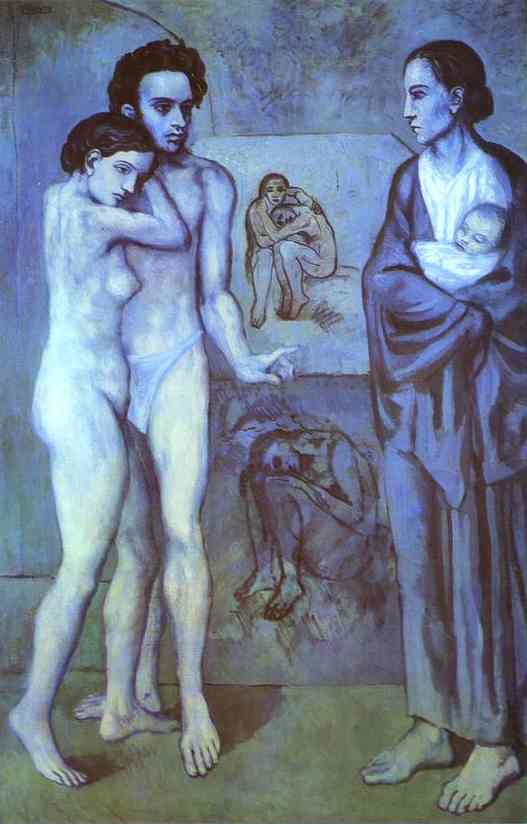


This period's starting point is uncertain; it may have begun in Spain in the spring of 1901, or in Paris in the second half of the year.[1]In choosing austere color and sometimes doleful subject matter?prostitutes, beggars and drunks are frequent subjects?Picasso was influenced by a journey through Spain and by the suicide of his friend Carlos Casagemas, who took his life at the L?Hippodrome Caf?in Paris, France by shooting himself in the right temple on February 18, 1901. This happened at a time when Picasso had begun achieving some success; according to art historian H??e Seckel, "it is difficult to say why the twenty-year-old Picasso abandoned the dazzling palette and exuberant subject matter that had already come to characterize his work. According to the artist, the suicide[...]marked the sudden onset of the blue period: 'I started painting in blue when I learned of Casagemas's death.'"[2]
Starting in the latter part of 1901 he painted several posthumous portraits of Casagemas, culminating in the gloomy allegorical painting La Vie, painted in 1903 and now in the Cleveland Museum of Art.[3]The same mood pervades the well-known etching The Frugal Repast (1904), which depicts a blind man and a sighted woman, both emaciated, seated at a nearly bare table. Blindness is a recurrent theme in Picasso's works of this period, also represented in The Blindman's Meal (1903, the Metropolitan Museum of Art) and in the portrait of Celestina (1903). Other frequent subjects are artists, acrobats and harlequins. The harlequin, a comedic character usually depicted in checkered patterned clothing, became a personal symbol for Picasso.
Possibly his most well known work from this period is The Old Guitarist.Other major works include Portrait of Soler(1903) and Las dos hermanas (1904). Picasso's Blue Period was followed by his Rose Period.
References
Sources
- Cirlot, Juan-Eduardo (1972). Picasso: Birth of a Genius. New York and Washington: Praeger.
- Wattenmaker, Richard J.; Distel, Anne, et al. (1993). Great French Paintings from the Barnes Foundation. New York: Alfred A. Knopf. ISBN 0-679-40963-7
- http://en.wikipedia.org/wiki/Blue_Period
- Becht-J?dens, Gereon; Wehmeier, Peter M. (2003). Picasso und die christliche Ikonographie. Mutterbeziehung und k?stlerische Position. Berlin: Dietrich Reimer Verlag. ISBN 3-496-01272-2