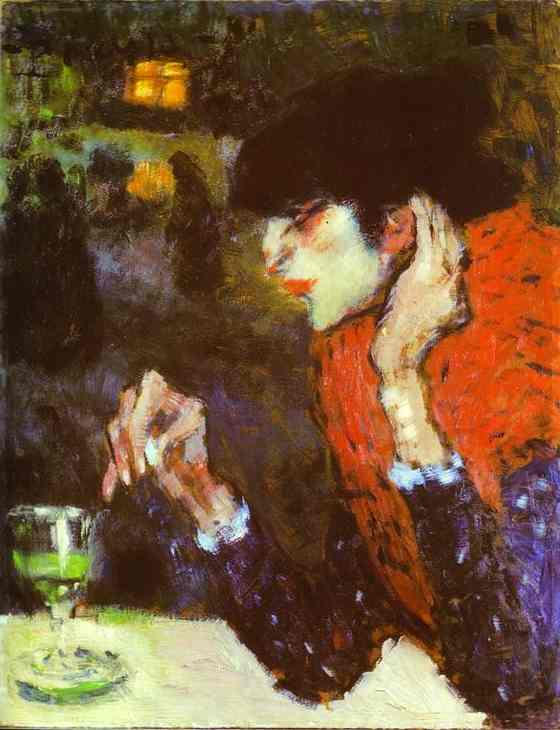
Pablo Picasso - The
Absinthe Drinker, 1901
Oil on cardboard.
Melville Hall Collection, New York, NY, USA.
Blue Period - Pablo Picasso
(*)
At the turn of the century Picasso moved from Spain
to France, living and working mainly in Paris, and also on the south
coast towards the end of his life. The incredible catalogue of work
produced by Picasso is generally placed into overlapping phases of
development, known as periods, each with a distinct content and
variety of techniques.
The popular Blue Period lasted from roughly 1901 to 1904 a time when
the struggling young artist was following in the footsteps of
Toulouse-Lautrec and the 19th Century symbolists. The works from
this period obviously reflect well-established styles characterised
by the singular tones and hues of Picasso's predominantly blue
palette, creating melancholy images containing poignant subject
matter filled with despair.
Picasso's personal life was very difficult at the beginning of the
20th Century, as well as being a late teen, away from home for the
first time, and living in very poor conditions, his close friend
Casagemas committed suicide. This tragic loss added another layer to
the psychological depths of the paintings from the Blue Period.
Excellent examples from the period depict gaunt Madonnas, saints,
and an assortment of beggars of El Greco, including Woman and Child
by the Sea (1902), Blue nu (1902), The Tragedy (1903) and The Old
Guitar Player (1903). These and the other pieces typical of this
early work by Picasso are rich with symbolic colour, exaggerated
form, and abstracted spaces.
During this period the great artist began to sign his works
"Picasso" instead of "Pablo Ruiz y Picasso."
Quote:
http://www.rentspain.com |